What is nasal filling?
Nasal Filling is the process of eliminating nasal curvatures and low nose with melting filling materials that do not require surgical procedure and do not harm the body. Rhinoplasty dating back to 600 BC, and filling processes, Orlando Rou, in 1891, conducted studies on the modern sense that the shape structure of the nose could be corrected from the subcutaneousness. Jacques Joseph, on the other hand, developed his own technique in 1931, enabling the filling process to develop. Joseph, in his study with his students, was first staged by performing the nasal tip surgery, and then his bones were broken and brought to the middle section. It was tried to perform the procedure without removing the nasal tissues and roof oils as much as possible. Thus, the healing process was made predictable. Thanks to all developments, the understanding that there is no nose technique, only the appropriate approach technique, has been adopted. It has been understood that not only in terms of health, but also with aesthetic concerns, deformities in the nose will be prevented with filling material, as well as procedures.
Thanks to technology and successful studies, changes are made in the nose projection and symmetrical non-surgical nose procedures are performed on the face. In this way, from the tip of the nose to the nasal arch; From crooked nose procedures to revision, to low nose tip in the nose, many procedures have been performed today.
What are the types of nasal filling?
Nose Filling Processes nose job. Since there is no surgical procedure like The filling types, which are generally used to remove wrinkles, elimination and eliminating signs of aging, are also used in nasal filling processes. These are
- collagen
- hyuronic acid
- Calcium hydroxylapatite
- Poly-L-lactic acid (PLLA)
- Polymethylmethacrylate particles (PMMA)
Collagen filler
Collagen filling material, which provides subcutaneous recovery, provides permanence in the nose for 3 or 6 months.
Hyluronic acid filler
Hyluronic acid-based fillings, which have melting properties under the skin, provide permanence under the skin for a year. It is among the most preferred in permanent nasal filling procedures.
Calcium hydroxylapatite filler
The semi-permanent calcium hydroxylapathite filling material can remain under the skin for approximately 18 months. It is not preferred because it slows down the movement of the muscles in lip filler procedures.
Poly-L-lactic acid (PLLA)
It remains under the skin for approximately 2 years by making it to the appropriately eaten area in certain periods.
Polymethylmethacrylate particles (PMMA)
Among the filling types, the most permanent one is only the risky one. Therefore, it is among the least preferred ones.
In addition, apart from these procedures, the person’s own fat is taken and also&bsp;fat injection by applying aesthetic nose is obtained or eliminated the tip of the nose tip.

How to Make a Nose Filling?
- First of all, the doctor checks whether the nose structure is suitable for filling.
- Then, if requested to see before the nose filling, the nose picture is taken.
- nose Anesthetic cream is applied in order to be able to perform the appropriate one with the advice of a doctor.
- After waiting for the anesthetic cream for 15 or 20 minutes to affect the nose, the area where the procedure will be performed is disinfected with an antiseptic solution.
- Then, in order to create a large nose reduction process, an arched nose, curved nose, nose drops, an upturned nose is injected into the appropriate dose of filling material under the skin where necessary.
- the desired beautiful nose If there is a cream recommended by the doctor for 3 days after it is obtained, it should be applied without interruption.
Is the nasal filling permanent?
The permanence period of the nasal filling varies from person to person, depending on the reaction of the body. It provides permanence between 8 and 16 months after the first filling process. After the second filling process, permanence is provided for up to 2 years. Generally, the permanence of the filling is protected by the body for at least 8 to 1 years, depending on the material used.
The nose structure takes its full shape after puberty and does not change again. For this reason, if there is a deformation in the nose after the age of 20, permanently nose reduction surgery, procedures such as nostril reduction surgery can be performed. In addition, some deformations with nose filling processes are also removed and aesthetic nose view is obtained. In order to see the difference in the nose, it can be taken before and after the nose to see the change in months after the nose filling.
What are the advantages of nasal filling?
There are many advantages of filling procedures in non-surgical rhinoplasty. These are;
- Swelling after nasal filling does not affect social life in a short time and ensures that life does not take a break.
- Within a maximum of 15 minutes, the procedure is completed without pain and pain does not occur after the filling.
- Aesthetic nose surgeryAccording to the prices of nasal filling prices are very low cost.
- Aesthetically, the nose that the person wants to have is formed for a short time.
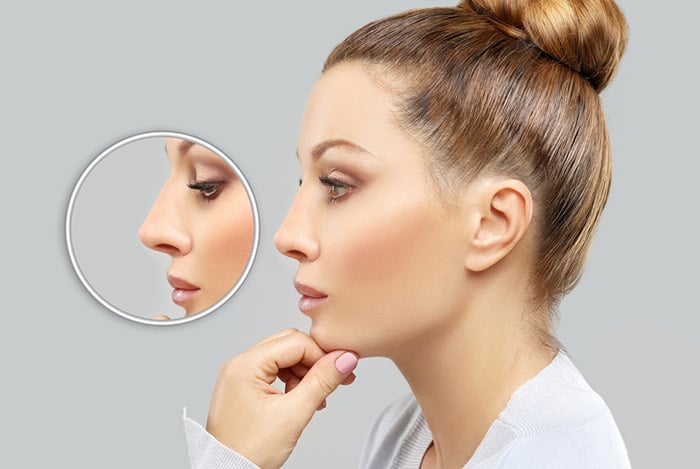
What are the Nose Filling Harms?
Fillers, which do not cause any permanent damage, sometimes cause temporary complications in the body. After filling in the person’s body, an allergic reaction such as bruising, swelling, tingling or redness may occur. Ice can be applied for all reactions. If the doctor has a recommendation in this regard, care should be taken to perform the procedure he recommends. However, all of these pass after a certain period of time according to the sensitivity rate of the body. All materials used in filling processes are among the medical aesthetic procedures approved by the FDA, which do not harm the health of the person.
To whom is the nasal filling applied?
- Persons whose nose tip shape is low due to congenital or trample causes (accident, bump, fall)
- People who are afraid to have aesthetic nose surgery,
- People who are not satisfied with the structure of the nose projection,
- In people with asymmetry and disproportion in the nose,
- In people who are older than adolescence and do not have any chronic health problems,
- Nasal filling offers a technically practical solution for people who play the nose and are uncomfortable with it while they are talking.
To whom is the nasal filling not applied?
- People with large noses may not be suitable, depending on the person’s face line.
- If there is a deformation that cannot be dissolved by fracture, curvature or filling on the inner or outer surface of the nose, the filling process is not applied.
- The edges of the nose are not suitable for people who want to reduce them with a filling process in people with wide noses.
- It is not appropriate to have a filling procedure for those who want to have a nose surgery.
How much does a nose filler cost?
The price of the nose filling varies according to the preferred center, the filling material used and the quality of the center. For this reason, the doctor and hospital that will perform this procedure should be investigated and the hospital that proves its own success should be preferred. Before choosing the center, price and performance evaluation should be made and places where unqualified skin damages should not be preferred, considering that it is cheaper. Instead, centers such as Estethica, which always adopt personal health and expectations and add added value to their life, should be preferred. Estethica also does not neglect to be accessible in order to meet the expectations of all segments.