What is rhinoplasty?
Rhinoplasty is the medical name of the operation we know as rhinoplasty. Apart from its aesthetic purpose; As a result of the accident, nose fractures are also applied to correct diseases such as physiological nasal disorders.
Rhinoplasty is generally preferred in the following situations:
- Aesthetics: When the person is not satisfied with the appearance of his own nose, rhinoplasty can be applied if he is a suitable candidate for the procedure.
- Removal of Nose-Related Disorders: Some patients can be preferred to relieve discomfort that may occur due to congenital or later accidents.
Rhinoplasty is customized by the specialist doctor depending on the expectations and needs of the patient. During the operation, changes can be made in the nasal cartilage and bone, the tip of the nose can be corrected and lifted, the back of the nose can be thinned and corrected, and the nostrils can be reduced or enlarged. This is determined entirely during the consultation according to the patient’s wishes and needs.
What are the types of rhinoplasty?
In surgeries performed to make the nose symmetrical, harmonious and proportional to the face, its types vary depending on the problem in the nose. These are;
- Rhinoplasty due to deformity (primary rhinoplasty)
- Complicated (revision) aesthetics (complicated rhinoplasty)
- Nose Aesthetics (Tipplastic)
- Aesthetics due to breathing problem (septorinoplasty)
- Concha Surgery
- Breathing Problem Surgery (Septoplasty)
- Non-surgical rhinoplasty
1- Rhinoplasty due to deformity (primary rhinoplasty)
It is an aesthetic operation performed to enter deformities in the nose, which is generally preferred in nose surgeries. If there is a nasal arch that disrupts the facial symmetry, the nasal arch is removed, the cartilages are reduced if necessary, and the projection of the nose is shortened.
2- Complicated (revision) aesthetics (complicated rhinoplasty)
Repetition of surgeries that have undergone nose surgery before but still the problem is not resolved is called complicated or revision. In revision surgeries, the nose is restructured in terms of appearance and a healthy, aesthetic nose is obtained.
3- Nose Tip Aesthetics (Typplastic)
It is a type of surgery performed in order to eliminate my deformity at the tip of the nose, without touching the area where the nasal arch is, in which the cartilage structure of the nose is intervened.
4- Aesthetics due to breathing problem (Septorhinoplasty)
It is a type of operation in which the nose is shaped aesthetically, as well as the breathing problem is eliminated. In rhinoplasty, arch and cartilage curvatures are intervened, and the structure that prevents breathing is corrected.
5- Concha Surgery
Meats in the inner part of the nose are called ‘contains’. Conchas grow over time due to environmental reasons and physiological reasons, sometimes by showing allergic symptoms and preventing oxygen from the airways. In the operation performed in rhinoplasty, the concha in the nose is reduced, thus making breathing easy through the air ducts.
6- Breath Problem Surgery (Septoplasty)
In nose surgery, it is the procedure performed by interfering with the polyp, turbinate or septoma that prevents breathing only in the nose, without any aesthetic concerns. Septoplasty operation provides more comfortable breathing by intervening in the nose. Thus, the quality of life of the person is increased.
7- Non-surgical rhinoplasty
Non-surgical rhinoplasty, which is called ‘liquid rhinoplasty’ in medical terminology, is a type of non-surgical aesthetic that is applied to the outer surface of the nose without the need for anesthesia, just to remove deformities in the nose. Deforming in the nose of the person, nose filling method, in the projection image of the nose, filling is made with the injection method to the areas that disrupt the structure. This method is a temporary nose aesthetic method, and after a while, the filler melts without harming the body. Problems such as wrinkled appearance, contouring problems, low nose tips are eliminated with non-surgical rhinoplasty. As with open surgery, this technique has some advantages. Expert surgeons decide whether rhinoplasty should be closed or open.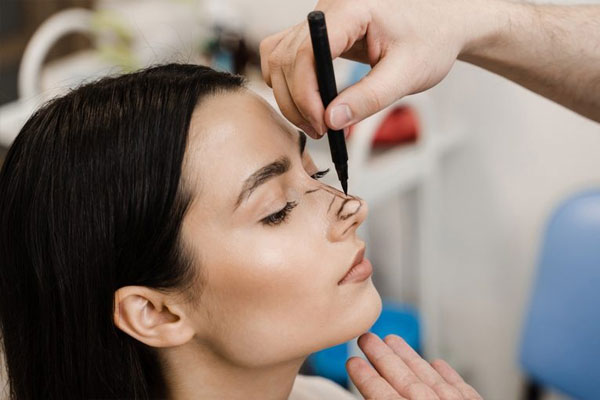
How should nutrition be before nose surgery?
Consumption of fibrous foods before nose surgery provides relief from digestion. Particular attention should be paid to the intake of foods that contain collagen and protein-intensities. 8 hours before the operation, all whole drinking consumption should stop.
What to do before rhinoplasty?
- Before the nose surgery, the person’s health history is evaluated. It is determined whether there has been a previous surgery.
- A blood test is taken the day before and checked whether the surgery is suitable.
- Eating and drinking should be stopped 8 hours before the operation so that anesthesia does not cause any complications in the body.
- D Smoking should be stopped at least 2 days before. Thus, the healing rate of the wound can be increased.
- Regular consumption of drugs, vitamin supplements and herbal tea should be stopped.
- If there is a regularly used drug, the surgical doctor and anesthetist should be informed.
- Photographs are taken from both side profiles of the person for before and after the nose surgery.
- Jewelry should not be worn and clothes that make you feel comfortable should be preferred.
How is rhinoplasty performed?
Nose surgeries are started by determining the appropriate nose shape for the person’s face under general anesthesia. In rhinoplasty surgery, the type of surgery is determined according to the internal structure of the nose, depending on whether there is a shortness of breath in the nose. If there is a problem such as sinusitis, the breathing problem is eliminated first. Then, if there is cartilage, bone structure, curvature in the nose, the curvature and septum are intervened and the shape of the nose is corrected, thus ensuring the final state of the nose.
What are the nose surgery techniques?
In nose surgery, 2 different techniques are used according to the doctor’s decision and the intervention to be made. These are;
- Open rhinoplasty
- closed rhinoplasty
Open rhinoplasty
Open nose surgery is usually the technique that is preferred due to the low nose end, bone curvature, large conchae in the nose (inner nasal flesh), a revision is required, the collapse of the nasal cartilage, and congenital factors. This technique makes it easier to remove deformity by more easily intervened in the cartilage and bone structure in the correct planning of the surgery.
closed rhinoplasty
In closed nose surgery, also known as scarless nose surgery, it is performed by throwing incisions into the inner parts of the nose. Healing time is faster than open nose surgery and the probability of permission is low. After the doctor’s examination, which technique will be used in the plastic surgery to be performed on the nose structure, the doctor decides on the technique that is deemed necessary.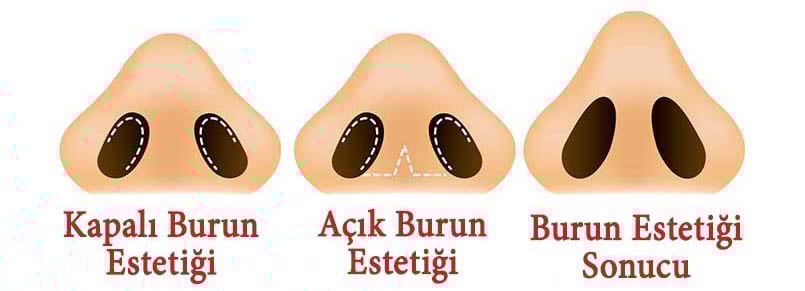
Should closed nose surgery or open nose surgery be preferred?
After the control made according to the intervention to the nose, he decides the surgery method. This situation is a decision to be made by the doctor and does not affect the person positively or negatively.
What should be done after rhinoplasty?
- After rhinoplasty, the head should be rested for 4 days in the position where the head will be up.
- Ice should be applied around the eyes for two days to prevent edema and swelling. However, ice should be kept away from the plaster on the upper surface of the nose.
- Since tampons are used in the nose, mouth breathing should be taken and plenty of water should be consumed for dry mouth.
- Sudden movements should be avoided.
- Sports activities should be interrupted and heavy items should not be lifted.
- The nose should be protected from all possible blows, and the movements that will cause trauma should be avoided.
- Care should be taken in movements such as blowing or sneezing that will damage the nose.
- It breathes easily after the nasal tampon is removed. However, the drugs given should not be continued under the control of a doctor.
- In order to increase the healing of internal crusting of the nose, the earwax can be soaked in oxygenated water and cleaned for the nose.
- Spicy foods that will cause the nose to scratch should be avoided, instead of easily consumed, digestion and supporting foods should be preferred.
- Care should be taken to consume vegetables, where fruit and fiber are concentrated.
- Since the nose will be sensitive in the first place after the nose surgery, it should be protected from sun rays and care should be taken to use sunscreen.
What are the advantages of rhinoplasty?
Rhinoplasty is a surgical procedure performed to improve people’s nose appearance and add balance to facial features. This aesthetic operation can improve not only its appearance, but also nasal functions. When done correctly, rhinoplasty can increase one’s self-confidence and help get a natural look. This operation allows the person to feel better and improve the overall quality of life.
What are the disadvantages of rhinoplasty?
In the first days of nasal aesthetic operations, which carry less risk than other types of surgery, numbness can be seen at the tip of the nose. However, this situation disappears with the fit of the nose shape. There is a risk of infection due to intranasal sensitivity. In order to prevent infection of the nose, care should be taken to take the drugs given by the doctor programmatically. Since the face area does not wash until the nasal bands come out, oily skin may occur. However, with the help of cotton, the face can be cleaned with soft touches without touching the nose.
To whom is rhinoplasty applied?
- Those with congenital or traumatic causes of deformity in the nose,
- Those who are dissatisfied with the fact that the nose is bony, crooked, or general appearance,
- Those with shortness of breath due to breathing problems,
- Those with polyps and nasal enlargement problems in the nose,
- Those with deformities such as low nose tip or uneven nostrils
- Those who only have aesthetic problems in the nose are suitable for rhinoplasty surgery.
Frequently Asked Questions About Rhinoplasty
Who cannot have rhinoplasty surgery?
It is not suitable for people who have a psychological dislike for themselves psychologically. Although the person has surgery and how aesthetically aesthetic it looks, it causes him to enlarge even the smallest flaw. At the same time, there is a possibility of encountering problems such as depression, reducing the quality of life, and problems in socializing.
It is not recommended for people with sleep apnea. The reason for this is the obstruction of the airways and the problem of shortness of breath. In order for the person to have rhinoplasty surgery, he may first have an operation for the sleep apnea problem. Then he can easily perform rhinoplasty surgery.
If the person who will undergo rhinoplasty surgery has a bleeding disorder problem, it is not considered appropriate. The reason for this is that if the blood does not coagulate during the operation, blood loss may occur. In order to overcome this problem, the person’s vitamin supplement should be questioned and situations that will prevent blood from clotting should be eliminated.
The procedure is an operation and interventions are performed under anesthesia. Therefore, the person does not feel pain or pain at that time. The pain that the person feels after the operation is not severe and is related to the high pain threshold.
Within the body of Estethica, nasal surgeries are intervened with sutures that melt into the nose. Therefore, there is no suture removal after the operation. The sutures fall spontaneously during the healing process of the nose in the later stages.